














How Brands Use OOH Media | Amplify Social Media Campaigns | Elyts
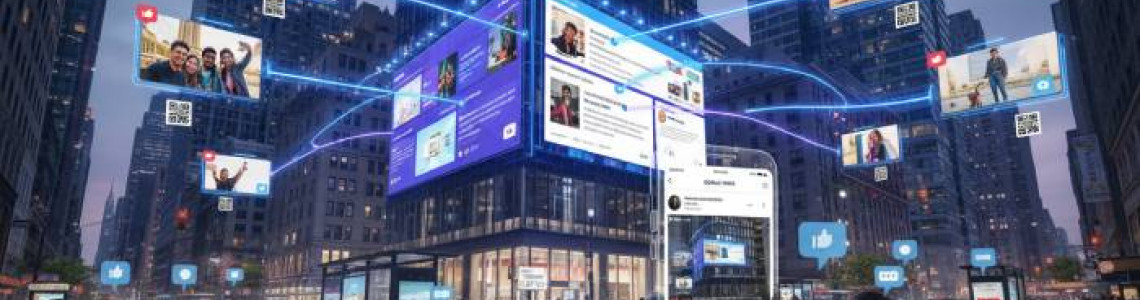
In today’s hyperconnected world, brands no longer treat Out-of-Home (OOH) media and social media as separate channels. Instead, they are blending the physical impact of OOH with the interactive power of social platforms to create campaigns that travel seamlessly from streets to screens. When used strategically, OOH media can significantly amplify social media campaigns by driving awareness, engagement, and user-generated content at scale.
The Power of OOH in a Social-First Marketing Era
OOH media offers something digital-only campaigns often struggle to achieve: unavoidable visibility in the real world. Billboards, transit ads, digital screens, and experiential installations reach consumers during their daily routines, creating strong brand recall. When this real-world exposure is connected to social media, it becomes a catalyst for online conversations.
Brands leverage OOH to spark curiosity, encourage sharing, and guide audiences toward digital platforms where deeper engagement happens. The result is a full-funnel strategy that combines mass reach with measurable social interactions.
Creating “Instagrammable” OOH Experiences
One of the most effective ways brands amplify social campaigns through OOH is by designing visually striking, share-worthy installations. Murals, 3D billboards, interactive displays, and creative transit wraps are built with social sharing in mind.
When consumers stop to take photos or videos and post them on Instagram, Facebook, or X, the OOH campaign organically extends its reach far beyond the physical location. A single installation can generate thousands of social impressions through user-generated content, often at no additional media cost.
Using Hashtags and QR Codes to Bridge Offline and Online
Successful OOH campaigns often include clear digital call-to-actions. Branded hashtags, QR codes, and short URLs help guide audiences from the physical ad to the brand’s social media ecosystem.
Hashtags encourage consumers to join a conversation, participate in challenges, or showcase their own content related to the campaign. QR codes can lead users directly to Instagram pages, campaign microsites, reels, or contests, making the transition from offline to online instant and frictionless.
Amplifying Social Campaign Launches with OOH
Many brands use OOH media as a high-impact launchpad for social media campaigns. A bold OOH rollout can create anticipation and buzz before or during a digital launch.
For example, teaser billboards with cryptic messages or countdowns can drive curiosity and prompt audiences to search for the brand online. When the social campaign goes live, the audience is already primed, resulting in higher engagement rates and faster momentum.
Leveraging Digital OOH for Real-Time Social Integration
Digital Out-of-Home (DOOH) media takes social amplification a step further by enabling real-time content updates. Brands can display live social media feeds, trending hashtags, influencer posts, or audience reactions directly on digital screens.
This two-way interaction makes consumers feel like active participants rather than passive viewers. Seeing real social posts featured on large public screens motivates more people to engage online, creating a powerful feedback loop between OOH and social media.
Influencer-Driven OOH Campaigns
Influencer marketing and OOH media are increasingly being combined for maximum impact. Brands collaborate with influencers to create content around OOH installations, billboards, or experiential events.
When influencers share their real-world interactions with OOH campaigns, it adds authenticity and credibility. Their followers are more likely to engage, visit the OOH location, or participate in the campaign online, multiplying reach across both physical and digital spaces.
Driving Social Proof and Brand Trust
OOH media lends credibility to social media campaigns. A brand that appears prominently in public spaces often feels more established and trustworthy to consumers. When audiences see a campaign both on the streets and on their social feeds, it reinforces consistency and brand authority.
This cross-channel presence strengthens social proof, making users more comfortable engaging with, sharing, and advocating for the brand online.
Measuring the Impact of OOH on Social Media Performance
Modern OOH campaigns are highly measurable. Brands track hashtag usage, social mentions, engagement spikes, QR code scans, and location-based social activity to evaluate performance.
By analyzing these metrics, marketers can directly link OOH exposure to social media growth, content virality, and audience engagement. This data-driven approach helps optimize future campaigns and justify OOH investments as part of a digital-first strategy.
The Future of OOH and Social Media Integration
As technology advances, the integration between OOH media and social platforms will only deepen. AI-driven personalization, augmented reality experiences, and programmatic DOOH will allow brands to deliver context-aware messages that encourage instant social interaction.
In the future, OOH will not just support social media campaigns—it will actively shape and fuel them in real time.
Conclusion
OOH media is no longer just about brand visibility; it is a powerful amplifier for social media campaigns. By creating shareable experiences, integrating digital touchpoints, and encouraging user participation, brands can turn physical advertising into a social engine. When OOH and social media work together, they create campaigns that are more engaging, memorable, and impactful across every stage of the consumer journey.
Elyts Advertising and Branding Solutions | www.elyts.in (India) | www.elyts.agency (UAE)
Related Products



Leave a Comment